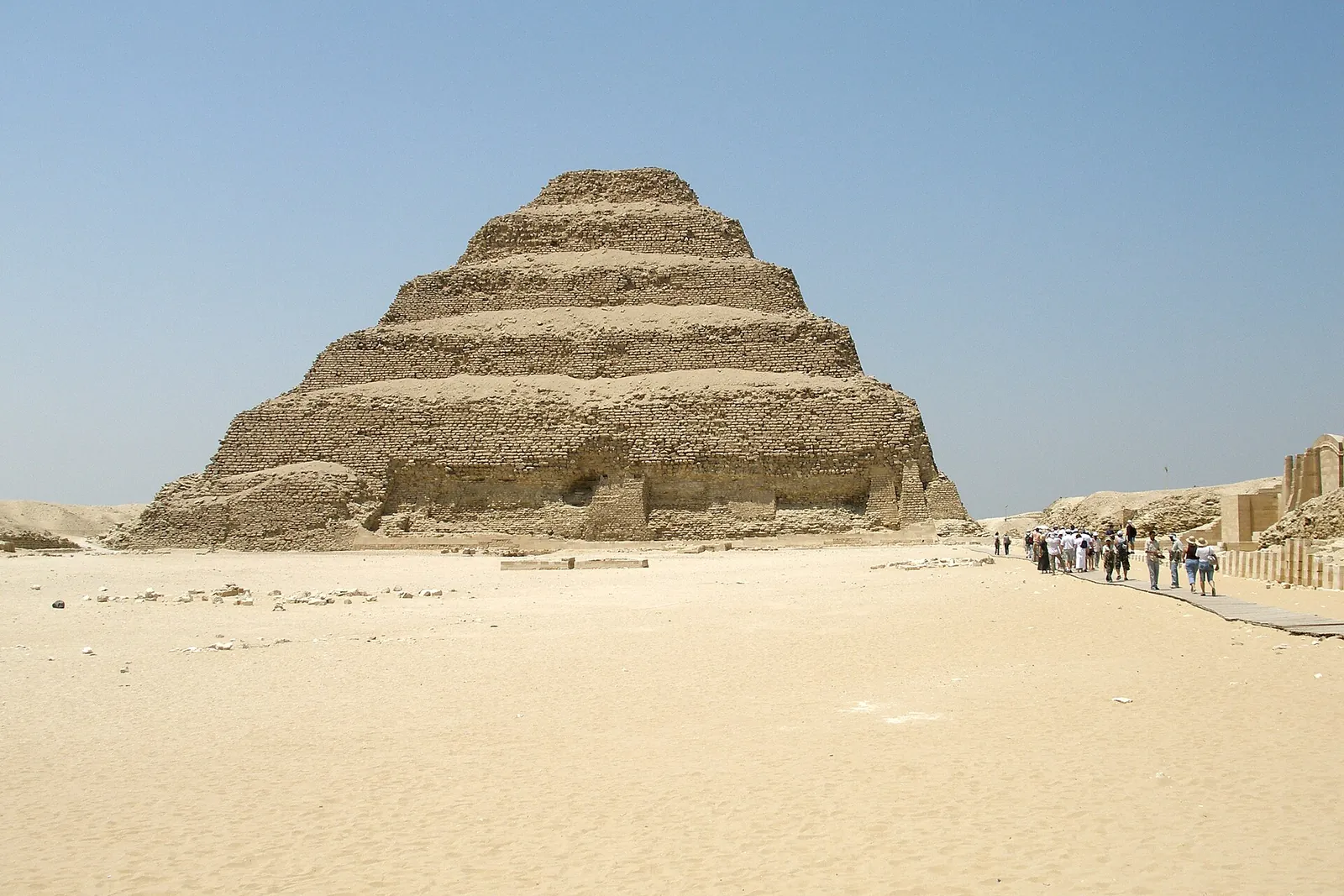
Enter a landscape where builders translated forms familiar from mudbrick, reed and wood into a new monumental language of cut stone. Narrative is used only where the evidence boundary remains visible.
SCENE 01 / T–2650
Before the skyline changed
The Saqqara plateau already held burials and memory before Djoser’s complex transformed the visual and political scale of building.
What survives
Material, text, architecture or environmental trace that can be inspected and cited.
What it may support
A reasoned connection that remains distinct from direct observation.
What is missing
Voices, dates, actions or relationships the current record cannot securely recover.
What changed later
Excavation, conservation, display and modern community shape what can be known now.
Scene protocol
- Name the primary evidence.
- Describe the interpretive step.
- State the uncertainty.
- Remove details added only for atmosphere.
TIME CHECK 1The Saqqara plateau already held burials and memory before Djoser’s complex transformed the visual and political scale of building. Which phrase is evidence, and which phrase is reconstruction?
SCENE 02 / T–2650
A material experiment
Stone did not arrive as an obvious solution. Blocks, columns, doorways and surfaces preserve experiments in making permanence imitate earlier materials.
What survives
Material, text, architecture or environmental trace that can be inspected and cited.
What it may support
A reasoned connection that remains distinct from direct observation.
What is missing
Voices, dates, actions or relationships the current record cannot securely recover.
What changed later
Excavation, conservation, display and modern community shape what can be known now.
Scene protocol
- Name the primary evidence.
- Describe the interpretive step.
- State the uncertainty.
- Remove details added only for atmosphere.
TIME CHECK 2Stone did not arrive as an obvious solution. Blocks, columns, doorways and surfaces preserve experiments in making permanence imitate earlier materials. Which phrase is evidence, and which phrase is reconstruction?
SCENE 03 / T–2650
Organising labour
Quarrying, transport, measurement and assembly required specialists, provisioning and administrative control beyond the image of a lone genius.
What survives
Material, text, architecture or environmental trace that can be inspected and cited.
What it may support
A reasoned connection that remains distinct from direct observation.
What is missing
Voices, dates, actions or relationships the current record cannot securely recover.
What changed later
Excavation, conservation, display and modern community shape what can be known now.
Scene protocol
- Name the primary evidence.
- Describe the interpretive step.
- State the uncertainty.
- Remove details added only for atmosphere.
TIME CHECK 3Quarrying, transport, measurement and assembly required specialists, provisioning and administrative control beyond the image of a lone genius. Which phrase is evidence, and which phrase is reconstruction?
SCENE 04 / T–2650
Ritual movement
Courts, barriers, false doors and controlled approaches structured bodies as well as views. Architecture performed kingship through movement.
What survives
Material, text, architecture or environmental trace that can be inspected and cited.
What it may support
A reasoned connection that remains distinct from direct observation.
What is missing
Voices, dates, actions or relationships the current record cannot securely recover.
What changed later
Excavation, conservation, display and modern community shape what can be known now.
Scene protocol
- Name the primary evidence.
- Describe the interpretive step.
- State the uncertainty.
- Remove details added only for atmosphere.
TIME CHECK 4Courts, barriers, false doors and controlled approaches structured bodies as well as views. Architecture performed kingship through movement. Which phrase is evidence, and which phrase is reconstruction?
SCENE 05 / T–2650
The pyramid grows
The stepped form records change rather than one instant design. Construction history remains a research question written into masonry.
What survives
Material, text, architecture or environmental trace that can be inspected and cited.
What it may support
A reasoned connection that remains distinct from direct observation.
What is missing
Voices, dates, actions or relationships the current record cannot securely recover.
What changed later
Excavation, conservation, display and modern community shape what can be known now.
Scene protocol
- Name the primary evidence.
- Describe the interpretive step.
- State the uncertainty.
- Remove details added only for atmosphere.
TIME CHECK 5The stepped form records change rather than one instant design. Construction history remains a research question written into masonry. Which phrase is evidence, and which phrase is reconstruction?
SCENE 06 / T–2650
What survives now
Restoration, excavation and modern access shape the monument encountered today. Ancient intention and present appearance are not identical.
What survives
Material, text, architecture or environmental trace that can be inspected and cited.
What it may support
A reasoned connection that remains distinct from direct observation.
What is missing
Voices, dates, actions or relationships the current record cannot securely recover.
What changed later
Excavation, conservation, display and modern community shape what can be known now.
Scene protocol
- Name the primary evidence.
- Describe the interpretive step.
- State the uncertainty.
- Remove details added only for atmosphere.
TIME CHECK 6Restoration, excavation and modern access shape the monument encountered today. Ancient intention and present appearance are not identical. Which phrase is evidence, and which phrase is reconstruction?
RECONSTRUCTION LOG
Six statements to complete
Before the skyline changed
Known: __________ Inferred: __________ Unknown: __________
A material experiment
Known: __________ Inferred: __________ Unknown: __________
Organising labour
Known: __________ Inferred: __________ Unknown: __________
Ritual movement
Known: __________ Inferred: __________ Unknown: __________
The pyramid grows
Known: __________ Inferred: __________ Unknown: __________
What survives now
Known: __________ Inferred: __________ Unknown: __________
SOURCE RETURN
Evidence trail
- Archaeological report or primary document.
- Institutional object or site record.
- Recent scholarly interpretation.
- Image creator and reuse licence.
Reviewed 16 July 2026. No fictional eyewitness is presented as historical testimony.