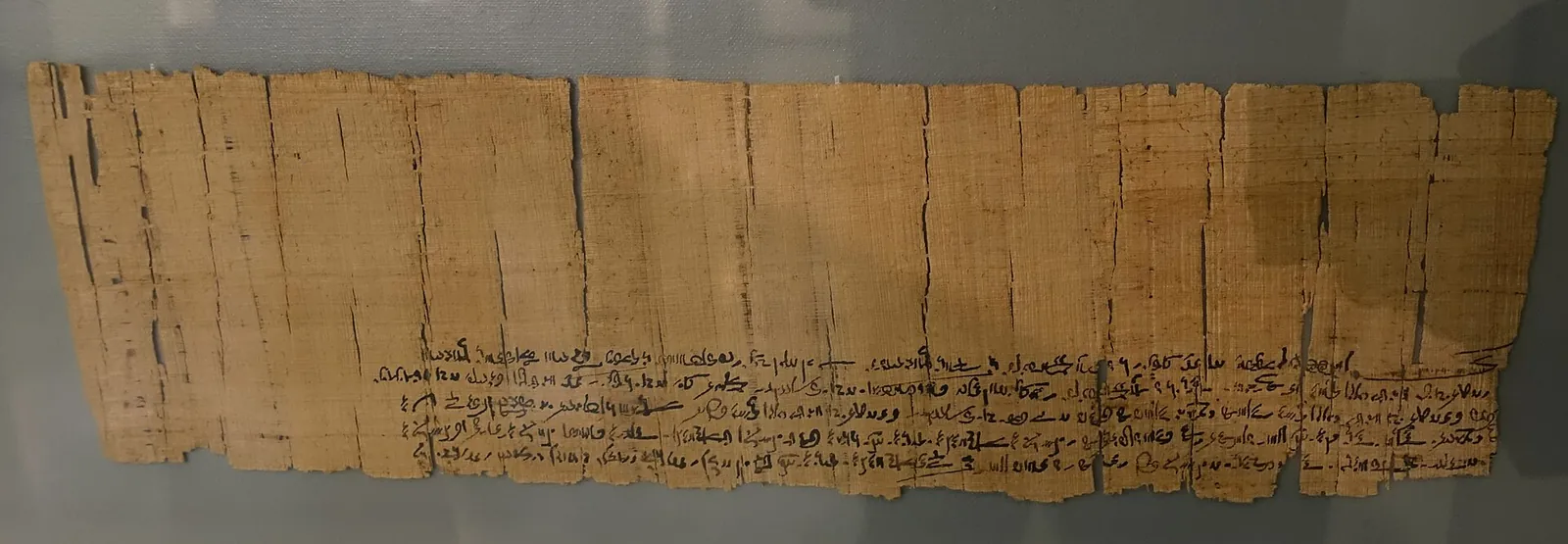
Trace a written page from fibre and ink to reading community, burial, excavation, conservation and museum case. Narrative is used only where the evidence boundary remains visible.
SCENE 01 / T+0350
Making a surface
Papyrus sheets joined agricultural material, specialised production and long writing traditions; parchment and other supports also circulated.
What survives
Material, text, architecture or environmental trace that can be inspected and cited.
What it may support
A reasoned connection that remains distinct from direct observation.
What is missing
Voices, dates, actions or relationships the current record cannot securely recover.
What changed later
Excavation, conservation, display and modern community shape what can be known now.
Scene protocol
- Name the primary evidence.
- Describe the interpretive step.
- State the uncertainty.
- Remove details added only for atmosphere.
TIME CHECK 1Papyrus sheets joined agricultural material, specialised production and long writing traditions; parchment and other supports also circulated. Which phrase is evidence, and which phrase is reconstruction?
SCENE 02 / T+0350
Choosing a language
Coptic used the Greek alphabet with additional signs to write Egyptian. Language choice connected readership, education and religious practice.
What survives
Material, text, architecture or environmental trace that can be inspected and cited.
What it may support
A reasoned connection that remains distinct from direct observation.
What is missing
Voices, dates, actions or relationships the current record cannot securely recover.
What changed later
Excavation, conservation, display and modern community shape what can be known now.
Scene protocol
- Name the primary evidence.
- Describe the interpretive step.
- State the uncertainty.
- Remove details added only for atmosphere.
TIME CHECK 2Coptic used the Greek alphabet with additional signs to write Egyptian. Language choice connected readership, education and religious practice. Which phrase is evidence, and which phrase is reconstruction?
SCENE 03 / T+0350
Writing and copying
A manuscript records hands, corrections, layout and use. “Text” is also an object made through time and labour.
What survives
Material, text, architecture or environmental trace that can be inspected and cited.
What it may support
A reasoned connection that remains distinct from direct observation.
What is missing
Voices, dates, actions or relationships the current record cannot securely recover.
What changed later
Excavation, conservation, display and modern community shape what can be known now.
Scene protocol
- Name the primary evidence.
- Describe the interpretive step.
- State the uncertainty.
- Remove details added only for atmosphere.
TIME CHECK 3A manuscript records hands, corrections, layout and use. “Text” is also an object made through time and labour. Which phrase is evidence, and which phrase is reconstruction?
SCENE 04 / T+0350
Reading together
Texts could be read aloud, taught, prayed and carried. Silent individual reading is only one possible modern projection.
What survives
Material, text, architecture or environmental trace that can be inspected and cited.
What it may support
A reasoned connection that remains distinct from direct observation.
What is missing
Voices, dates, actions or relationships the current record cannot securely recover.
What changed later
Excavation, conservation, display and modern community shape what can be known now.
Scene protocol
- Name the primary evidence.
- Describe the interpretive step.
- State the uncertainty.
- Remove details added only for atmosphere.
TIME CHECK 4Texts could be read aloud, taught, prayed and carried. Silent individual reading is only one possible modern projection. Which phrase is evidence, and which phrase is reconstruction?
SCENE 05 / T+0350
Fragment and collection
A surviving page may be separated from its codex, findspot or related fragments. Collection history controls what can be reconstructed.
What survives
Material, text, architecture or environmental trace that can be inspected and cited.
What it may support
A reasoned connection that remains distinct from direct observation.
What is missing
Voices, dates, actions or relationships the current record cannot securely recover.
What changed later
Excavation, conservation, display and modern community shape what can be known now.
Scene protocol
- Name the primary evidence.
- Describe the interpretive step.
- State the uncertainty.
- Remove details added only for atmosphere.
TIME CHECK 5A surviving page may be separated from its codex, findspot or related fragments. Collection history controls what can be reconstructed. Which phrase is evidence, and which phrase is reconstruction?
SCENE 06 / T+0350
Conservation under glass
Light, humidity, mounting and digitisation determine access. The most legible display is not always the safest long-term condition.
What survives
Material, text, architecture or environmental trace that can be inspected and cited.
What it may support
A reasoned connection that remains distinct from direct observation.
What is missing
Voices, dates, actions or relationships the current record cannot securely recover.
What changed later
Excavation, conservation, display and modern community shape what can be known now.
Scene protocol
- Name the primary evidence.
- Describe the interpretive step.
- State the uncertainty.
- Remove details added only for atmosphere.
TIME CHECK 6Light, humidity, mounting and digitisation determine access. The most legible display is not always the safest long-term condition. Which phrase is evidence, and which phrase is reconstruction?
RECONSTRUCTION LOG
Six statements to complete
Making a surface
Known: __________ Inferred: __________ Unknown: __________
Choosing a language
Known: __________ Inferred: __________ Unknown: __________
Writing and copying
Known: __________ Inferred: __________ Unknown: __________
Reading together
Known: __________ Inferred: __________ Unknown: __________
Fragment and collection
Known: __________ Inferred: __________ Unknown: __________
Conservation under glass
Known: __________ Inferred: __________ Unknown: __________
SOURCE RETURN
Evidence trail
- Archaeological report or primary document.
- Institutional object or site record.
- Recent scholarly interpretation.
- Image creator and reuse licence.
Reviewed 16 July 2026. No fictional eyewitness is presented as historical testimony.